Saturday, June 10, 2006

Angel


I am an angel. I live in outer space but you call it
Heaven. I sit immobile but you think I have wings.
Though I watch your every move, I have no stake
in your health or happiness. Though I manifest
my being in every moment of your lives, my actions
are petty and trivial. When you walk through the park
on the first warm day of spring, I’m the force
who makes the pigeon shit on your head.
When you sit in a stall in a public restroom
I’m the power who makes the toilet paper disappear
at the moment you’re ready to wipe.
I’m the desire that drives the cute little five year old
to give you the finger when you smile at him.
I am the knowledge that no matter what line
you pick at the supermarket it will be the slowest.

I am the reason Celine Dion is a huge star, the reason
your penis is two inches long, the reason your breasts
are as flat as the Great Plains. I am the bitter aftertaste
in sugar substitutes, your morning hangover. I am dandruff,
an ingrown toenail, a speck of dust in your eye, a pebble
in your comfortable new shoes. I am the fitful sleep in which
you dream and find yourself falling from a mountain.
I am the revelation in which you discover that you are
neither great nor original but empty-headed and common.

As for those greater catastrophes, those fatal accidents,
those terminal diseases, poverty, war, and famine, I stake
no claim. I compose neither good nor evil, justice nor injustice,
but convenience and inconvenience. All my works are shallow and trite.

I am merely an attendant, serving the way I was meant to serve.
following the orders of a monarch who devotes his time to greater things.
And when sirens echo in the distance I do not hear them.
When rivers overflow I do not see them washing away your cities.

In the beginning was the darkness, then came the light.
Though I am of that light I do not help you see.
And as you walk through your world as if blind, I give you
no hint of what’s to come, no sign telling you to go or to stop—
just an aching in your bones, the self-conscious knowledge
that somewhere, in the middle of this universe,
away from the greatness of kings, you exist.

Tuesday, April 04, 2006

FACE


1. Dear god grant me the strength
to destroy the things I can destroy,
words to deface the things I can't,
and wisdom to get away with it.

2. This is for the space between words, the slow
fall of mountains leaving the remains of giants.
There are wars we remember that took place in
our back yards, days when we thought we moved
backwards. The storyline has only been suggested,
through hints of color, and weather mentioned in passing.

3. I am so blown away by your concept of space.

4. There are images one gets lost in, images one
can breathe, a landscape in colors and stars,
the names you can’t remember. The clouds darken
over the sea surge. Seagulls climb on gusts of wind
as the night turns over into silence. The dream
of canyons, the dream of forgetting—I become
a new person, with no history, no origin, and a million
possible paths to take ahead of me, into the horizon.

5. What's wrong with your face?

Saturday, February 11, 2006

Miss Tahiti 1981


They stand there throwing lines at each other
inside the TV set. The music blazes
inside my head as a beautiful girl water skis.

"This music would be good to hear on the radio
while waking up, in a state of half-sleep."

I have a definite lust for life. Even here
in my room, set apart from all stages, I can feel
the so-called outside events, the latest American tragedy
and the heat, the rush of the leaves.

"Don't dance in Kansas City."

"Stay away from strange mist on the sea."

Because Miss Tahiti 1981 is the most beautiful girl I've seen today.

I carry burdens with me when I walk and the streets
aren't so mellow, though they too age along with
every oak and sparrow.

"New faces every day, new columns on buildings,
and words."

Miss Tahiti has one of those faces you'll remember
a long time, which is where her immortality lies.

If I don’t follow her advice I am so fucked.

Monday, January 23, 2006

After The Party (1992)


Drunk at four in the morning
my friend Eddie and I
are sitting in this young woman’s apartment
watching a Depeche Mode video.
On the floor in front of the TV
some guy she knows
is passed out and snoring
while she sits on the sofa
telling us we should pay attention
to the lyrics being lip-synched
by a skinny English guy
with a fancy haircut.
She’s sweet, bright
and still full of the
subtle energy of youth,
and though Eddie and I are each
mad about her in
varying degrees
we realize that watching
a Depeche Mode video
with her at four a.m.
as some amateur drunk
snores on the floor
is just a bit too much to take,
so we leave.

We walk down to the 7-11
and buy some cigarettes,
some bread, and two packages
of canned meatballs with gravy.
We go back to his place,
throw the meatballs with gravy
into a pan, add some cheese,
some leftover spaghetti,
some soy sauce,
and, after a moment’s thought,
throw the bread in the pan as well.
We’re starting to sober up now,
but we’re hungry
and this weird mix is, after all,
food of some sort.

Later, after finishing
every last bit of it,
we’re sitting at the table
saying nothing.
We’re both starting to
feel sick and depressed.
I wash the meal down
with a glass of water
and light a cigarette
as Eddie stares
at his empty plate.

Suddenly Eddie stands up,
walks over to the trash can,
and pukes for a full minute
or two.
When he’s done
I walk over to the refrigerator
and grab two cans of beer.
I crack them open and
set one down in front of Eddie.
He looks up at me,
wipes his mouth
with the back of his hand,
and with the light of dawn
coming in through the window
he says, “Shit, man,
It’s a brand new day.”

So we have a toast:
to canned meatballs with gravy,
to all night parties,
to amateur drunks,
to England and its fancy haircuts,
to all the pretty young girls in the world,
and to the sun
which rises high in the sky
over us all.

Saturday, January 07, 2006

BOB BACKLUND: Politics, Madness, and A Good Clean Shave in The Heart of Darkness

According to The Book of Revelation 13:5, "The beast was given a mouth for uttering proud boasts and blasphemies, but the authority it received was to last only forty-two months." After coming back from hibernation, Bob Backlund's authority as the World Wrestling Federation's number one Beast lasted only four days. But then this is the nineties, and despite the best efforts of the wild-eyed fanatics at PETA, a beast doesn't last very long in this era.

But blame that on the times, not on the beast. And, perhaps, on Madison Square Garden. Yes, Madison Square Garden.

For some people Manhattan's Heart of Darkness is Wall Street, where prematurely graying men in business suits nervously pace the floors while the words "buy" and "sell" go through their heads like savage mantras. For others it's the theater district, where the mantras include words like "Cats" and "Grease," and where, in the ultimate act of Broadway blasphemy, a man by the name of Mandy Patinkin has been anointed the Holiest of Holies. But for people like me who've never reached these depths of hell, Manhattan's Heart of Darkness has always been Madison Square Garden, the site of numerous brutal tests of endurance, among which one may count the many bloody wrestling matches, a week long engagement of The Grateful Dead, and the 1992 Democratic National Convention. And for the purpose of shedding some light on Bob Backlund's present situation, it will do us some good to look back at what went on at that convention. Hell, it may even do YOU some good as well.

As we well know, the survivor of that series was Bill Clinton. Having fought off the likes of Paul "Mr. Electricity" Tsongas and Jerry "Spaceman" Brown, Clinton suddenly rose from among the crowd to become The Man. Supporting his rise, amidst a deluge of multicolored balloons and confetti, was a crowd that was riddled with celebrities. Among them: Stephen Stills of the fat boy vocal group Crosby, Stills, and Nash (who presaged the fat boy tag team, Men On A Mission, by over twenty years); Jill Larson, who plays Opal on the soap opera All My Children (you may remember that Jesse "The Body" Ventura, before going the Kojak route, claimed he got his hair done at Opal's Glamorama in Pine Valley); and Bianca Jagger who was hanging out not with Mick ("Double J" Jeff Jarrett's more sophisticated cousin from across the sea) but with fashion poobah Calvin Klein.

A lot of things had changed since 1992, in wrestling and in politics. You'd think that with Hogan Hulk Hogan fleeing the WWF stables and taking with him, among other things, the Mouth of the South and the reconstructed cheekbones of Brutus Beefcake, that Bob Backlund might once again reign supreme in the WWF. Especially since Bob Backlund—once the ultimate do-gooder—is now looking more like the evil spawn of one of Sybil's more damaged personalities and the Marquis de Sade. After all, these are hard times, and it takes someone with a hard heart to make it to the top.

On the night before Thanksgiving, Bob Backlund, having put behind him the petty desire to please the fans, looked like the man to do it. Indeed, things were looking good for Backlund that night—just as they were for Bill Clinton back in 1992. But today it seems like Clinton will be going down in the history books as a single term commander in chief (or Jimmy Carter II). Which means that after four years you won't have Bill "Bubba" Clinton to kick around anymore. Though while Bill Clinton still has a couple of years left, Bob Backlund has already had his four days.

But I'm getting ahead of the story here again, moving on to the sad and terrible aftermath when what we should be doing, for the moment, is concentrating on the good old days. Days we can count on a single hand, with a finger left over to relay a parting gesture to the Heart of Darkness.

The good days began on the night of November 23d 1994, two weeks after an election which saw the defeat of such luminaries as Mario Cuomo and Ann Richards. Back in Washington D.C., having little reason to give thanks, I'd resigned myself to singing the blues, and so took to drowning my sorrows at The New Vegas Lounge, a smoky blues bar ten blocks away from the White House.

Accompanying me were two fellow writers, Eddie Dean and Jim Rogers, who ordered beer after beer while I tried to negotiate my way through the evening with a cheap Jack Daniel's substitute. Despite our attempts at frugality, we were overcharged for our drinks and treated like the demons who made it necessary to sing the blues. But maybe that was the price we had to pay, because in addition to the pick up blues band that was playing that night, The New Vegas Lounge had, showing on the television with the sound turned off, The WWF Survivor Series.

As my friends didn't have much interest in wrestling, they busied themselves watching a guitar player by the name of Sky Shaw break into a rendition of "Crossroads." All the while my eyes were glued to the TV set, and when Bob Backlund applied the chicken wing to Bret Hart, I let loose with a hearty, "Break his neck, Bob!" Eddie looked over to me and asked, "Who's that?"

"That's Bob Backlund," I said reverently. "But I like to call him The Beast."

When Stu and Helen Hart walked over to ringside to throw in the towel it looked like the good times were back again, because Bob Backlund was, once again, the WWF Champion. Holding both the belt and his head high, Backlund looked down upon the masses and with a single facial expression said what would always take Bret Hart an entire interview to say: "I am the best."

Back in the New Vegas Lounge the band stopped playing and the other bar patrons stood in silence, gazing upon the perfect countenance of Bob Backlund. My friend Jim Rogers, who had finally found his curiosity piqued by the happenings on the television screen, held his head up high in turn and declared, "Now that's a guy who looks like a champion! The other guy's just another greaseball loser." Which goes to show what was always part of Bob Backlund's charm: whether he was being good or being bad—whether he was babyface or Beast—even people who weren't fans of wrestling knew that he was real thing, while someone like Hulk Hogan was nothing more than a Saturday morning cartoon character.

With Backlund back where he belonged, I went up to New York the following Sunday to see for myself the new champion defending his belt against Diesel, the overgrown meter man from the gas company, ready to celebrate Bob Backlund's first successful title defense.

Getting off the train at Penn Station in New York, I relished the memory of the past four days, days that brought back a air of wealth and good feelings. But just as Madison Square Garden would eventually work its curse on Bill Clinton, so it would on The Beast.

Possessing more wrestling skill in a single raised eyebrow than Diesel has in his entire seven foot body, Backlund should have been able to make quick work of Diesel. But this was Madison Square Garden. And while Bill Clinton won his ascendancy at Madison Square Garden, Bob Backlund lost his at that very same space. Because what Madison Square Garden giveth, Madison Square Garden will taketh away—though even if you didn't get it at Madison Square Garden, Madison Square Garden will wrest it from you anyway. It is, after all, The Heart of Darkness, and as such has no sense of mercy, no sense of right or wrong.

Like a Democrat donkey going up against a Republican rogue elephant, Backlund tried to take his stand. He used all the weapons he had at hand—an arm whip, an elbow smash, a monkey flip—but nothing worked, not even his trademark chicken wing, the submission hold that had brought many more skilled opponents to their knees. In the end it was Diesel who prevailed, putting Backlund down for a three count.

But unlike when he lost the belt to The Iron Sheik a decade ago, Backlund shed no tears, did not hold his head in his hands, remorseful that he'd disappointed his fans. No, this time he held his head high.

Back in the dressing room he immediately lathered his face with shaving cream and pulled out a razor. "I've found that it's always a good idea to have a shave after a match," he explained. Even though he's a beast, he's a CLEAN beast. When he was done, he wiped his face, then began reflecting on the night's events. "I have wrestled with Diesel," he said, as he opened up a bottle of Mennon Skin Bracer and splashed the stinging lotion on his cheeks. "It was the most unexciting contest imaginable, taking place in an impalpable grayness, without clamor, without glory, without the great desire for victory, without the great fear of defeat, in a sickly atmosphere of tepid skepticism, without much belief in my own right, and still less in that of my adversary." He paused, then held out his bottle of Mennon Skin Bracer. "Here, have some. It's good even if you haven't just shaved."

Strange words from a strange man. And although some may take these words as a sign of madness, others will contend that Backlund has simply EVOLVED, moving on to a realm where victory and defeat are mere words—words which are of no concern to him. But maybe that's just because his work in this world is done; and after going through a perfunctory series of rematches with Diesel, Bob Backlund—The Beast—will disappear again.

But then you may remember that according to The Book of Revelation there is a second beast, a beast that will force "all men, small and great, rich and poor, slave and free, to accept a stamped image on their right hand or forehead." A beast that "will not allow a man to buy or sell anything unless he is first marked with the name of the beast or with the number that stood for its name." Maybe it's also a beast that will find a way to survive The Heart of Darkness.

Of course it's possible that that beast will just be Bob Backlund again, this time wearing a mask. And a different aftershave. Something like Brut.

****************************************************

Originally published, in June, 1995, in Wrestling World. A lot of this story is actually true. Stephen Stills, soap opera actress Jill Larson, and Bianca Jagger (accompanied by Calvin Klein), were, like me, among the guests at the 1992 Democratic Convention at Madison Square Garden in New York. And I actually was at the New Vegas Lounge with old friends Eddie Dean and Jim Rogers, watching the wrestling match where Bob Backlund actually did defeat Bret Hart to regain the WWF title. Of course, just about everything else written here about Bob Backlund was completely made up. But that, thanks to my old friend Stephen Ciacciarelli, the former editor of Wrestling World, was the joy of writing about wrestling.

As for Bill Clinton being a one term president, that wasn't fiction. That was just wrong—though at the time things weren't look very good for him (and this was
before Monica Lewinsky).

One final note: Bob Backlund, in 2000, actually ran for the United States House of Representatives. A Republican, he lost. Nowadays, he runs a bail bond company in Connecticut.

Thursday, December 15, 2005

The Erotic Landscape of New York (an excerpt from The Edge of the World)

When I moved to New York City I was struck by the sensuality of the landscape. I mean, I knew about the sensuality of the women there—indeed, when I was just a visitor to the city that was the thing that stood out most in my mind. But only upon moving to New York, and becoming a resident, did I begin to fathom that the physical structure of the city itself was rife with concupiscent images.

First were the twin towers of the World Trade Center. Seeing them on the drive into town they seemed like mere skyscrapers, nothing more than concrete, steel, and glass. It was an image that bespoke not of sensuality but of those decidedly non-erotic activities of business and industry. Yet, beholding the towers from a closer perspective, while standing on the far side of West Street, I began to see something else; and what I saw were a woman's legs, stretched upwards towards the sky as if to anticipate the crucial moment when, spreading them, she allows her lover to enter her.

I often took walks to West Street for this very reason. There was a spot, about two thirds of the way down from Carlisle Street going towards Rector, where the erotic effect was at its most vivid. And in moments of fancy I could practically hear the conversation between this very long legged woman and her unseen lover—conversations in which she would at first tease him, even scold him, before begging, like a desperate woman just set loose upon the soil of Manhattan, to be fucked and fucked hard.

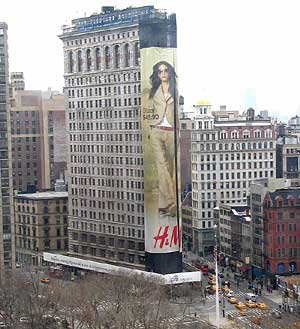
The next area of Manhattan to have erotic implications for me was the neighborhood around the Flatiron Building. Whenever I ventured there I found myself enamored by the fragrance of the neighborhood—though perhaps "fragrance" isn't the right word as "smell" is the word which best describes what entered my nostrils upon my heading up Broadway towards Twenty-Third Street. It was a smell not unlike that which permeates the atmosphere around the open-air fish stalls in Chinatown, which is to say that it was the smell of a woman.

I investigated this matter over the course of a few weeks, at the end of which I discovered that the smell was emanating from The Flatiron Building itself. It seems that through its triangular shape (and through some variety of sympathetic magic), this famous New York structure had become a gigantic working replica of a woman's genitals, with the wide area of the triangle at Twenty-Second Street being the beginning of the pubic region, and the narrow tip at Twenty-Third Street being the entrance to the vagina.

Not surprisingly, I found that gently rubbing The Flatiron Building at this point would cause moisture to seep through the stone. Soon the masonry itself would give way, becoming fleshlike, so that I could insert my fist, or entire arm even, into the building's viscous opening. In fact, on a few very pleasant occasions, I was able to place my entire head into the opening, happily lapping up the building's moisture as I caressed the soft outer masonry with my hands.

Although there were other structures in New York with similar erotic qualities, The World Trade Center and The Flatiron Building were, for me, the most significant. There were days when, despondent over the loss of loved ones, I found my salvation in these solid forms. When, through the static state of their being, I found both comfort and knowledge—and a sense of calm separation from those forms which, by their fleeting nature, eluded me.

And in the strange days which lie ahead—days when the incidents of my past life fade into shapeless anecdotes to go along with the odd trinkets I leave behind—these structures, although they never belonged to me, will be as a legacy bestowed upon my memory, speaking even more than these words of who I am or who I was. And though these great structures may one day be destroyed, their memory will remain, carrying me through an eternity which persists beyond streets and skyscrapers, beyond continents and oceans, beyond the air itself and that final, shiver inducing cataclysm we call The Edge Of The World.


Excerpt originally published in Pink Pages, 1995.

Tuesday, December 06, 2005

A True Star

My friend Michael and I
are sitting at an outdoor cafe
on Avenue A, drinking beer,
when we spot Lady Miss Kier,
the singer of the hot new band
Deee-Lite.
She’s walking down the street
dressed in a psychedelic body suit
which she fills with sweet curves
and pleasant oases of darkness.

Everyone at the cafe,
everyone on the street,
and everyone in the windows
of the buildings on Avenue A
stop eating, drinking, driving
to watch Lady Miss Kier
as she goes by,
and my friend Michael says,
“Now there’s a True Star.”

And with those words I start to wish
that I had the sort of talent
and presence that could give me
such fame and admiration.
But the only talents I have
are for drinking beer
and fucking up.
Very common talents, yes,
but I’m working on
doing them with great style
and in great proportions,
so that one day,
when I walk down Avenue A
to the store to buy beer,
people will stop and say,
“Hey, that guy’s
the biggest drunk in town.”
People will stop their cars
in the middle of the street,
walk up to me and say,
“You’re the guy who came to town
and fucked up REALLY big...
Can I have your autograph?”

“Sure,” I’ll say,
and I’ll sign his copy of
Fuck-Ups Of The Lower East Side
with the words,
“From a great fuck-up
to a little fuck-up.
Here’s looking
down
at you.”

Originally published in Rant, 1993.

Tuesday, November 22, 2005

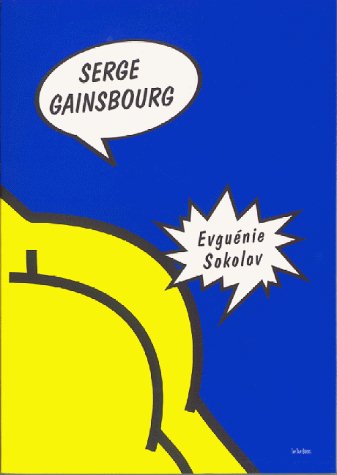
Evguénie Sokolov

by Serge Gainsbourg
translated by John and Doreen Weightman
TamTam Books

Like Charles Bukowski, Lucien Ginzburg was a lecherous dog of a man. Blunt, obscene, and, at times, even childish, both were men of pronounced appetites. Born in Germany in 1920 to an American soldier and a German woman, Bukowski came to the U.S. with his family at the age of three; soon the German tongue, which he had heard everywhere in his first few years, began to slip away from his memory. Born in Paris in 1928, Lucien Ginzburg was the son of Russian Jews who had fled the Bolshevik revolution; in time, Lucien’s father changed the family name from Ginzburg to the more French sounding “Gainsbourg,” with Lucien being reborn as Serge Gainsbourg. Bukowski grew up to work a series of dull, boring jobs before finally becoming a writer; Gainsbourg had a similar work history before he began earning his pay as a musician. And although both were controversial, each came to be highly regarded in their respective fields—in Europe, anyway.

Bukowski eventually gained some measure of respect back in the U.S. But Gainsbourg hasn’t quite made it over here, where for a long time he was known only for “Je t’aime... Moi non plus,” his 1969 song which, featuring the orgasmic moans of his then girlfriend, actress Jane Birkin, created a scandal worldwide. As far as America was concerned, Gainsbourg was a one hit wonder.

Across the ocean, however, his fame continued. Gainsbourg went on to romance the likes of Brigitte Bardot, Catherine Deneuve, and Isabelle Adjani, among others. The list of his lovers goes on and on—not bad for a man no one would describe as a pretty boy. But sometimes it was unrequited lust. As in a video from 1985 where Gainsbourg shared a bed with his teenage daughter, Charlotte, and gazed at her longingly through bloodshot eyes as she sang his song, “Lemon Incest.” Or that time when, during a live French television broadcast, Gainsbourg declared, “I want to fuck you” to fellow talk show guest Whitney Houston.

Gainsbourg was, above all, an honest man. Whether you liked it or not, he said whatever was on his mind, and for that the French awarded Gainsbourg the prestigious Croix d’Officier de L’Ordre des Art et Des Lettres. When Gainsbourg died on March 2, 1991, it was something akin to a national day of mourning in France. Because no matter how much he shocked or provoked, his French audience at the very least appreciated and, in many cases, revered him.

Gainsbourg is now becoming more widely known in the United States. But with the dark irony of his songs being lost when left untranslated, it’s no wonder that those who’ve heard only his early jazz inspired pop songs take him simply as a kitschy performer of French “lounge” music. (As it was, Gainsbourg employed, at various times, elements of jazz, African, rock ‘n roll, reggae, rap, even classical music—the melody for “Lemon Incest,” in fact, was a takeoff from one of Chopin’s etudes).

Recent English language covers of his songs by musicians like Nick Cave associate Mick Harvey haven’t helped much in changing the more limited perception of him. So while in France he was considered “on the edge” by young and old alike (at many concerts he performed towards the end of his life, the audience was made up of a majority of teenagers), here he is still seen as an oddball rather than as a “cutting edge” artist. Gainsbourg himself expected as much, and when asked if he had any plans to perform in the U.S., replied, “Why bother? They wouldn’t understand.” Indeed, as Russell Mael of the band Sparks notes, Gainsbourg’s musical satire isn’t easy for many Americans to “get.”

But music wasn’t Gainsbourg’s only means of expression. He was also a photographer, filmmaker, actor, and writer; and in 1980 Gainsbourg published Evguénie Sokolov—his only (and very brief) novel—which has now been reissued here in the U.S. Like much of Charles Bukowski’s work, it presents a first person narrator who’s a little on the rough side, and places him in a rather preposterous situation—the situation here being that Evguénie Sokolov, a painter, has found that his lifelong malady of excessive flatulence has helped him improve his art:
“...while I was testing my mastery by practicing the drawing of sewing needles with a single movement of the pen—a down stroke, then an upward stroke to open the eye, followed by a down stroke to close it—a particularly violent explosion of wind broke a pane in the glass roof, causing my hand to shake like that of an electrolytic child...”

Seeing that farting while in the act of drawing has bestowed “a dazzling beauty” upon his lines, Sokolov builds a contraption out of a bicycle seat and springs. Sitting on this as he draws, Sokolov quickly produces a series of forty “gasograms” and shows them to the most important art dealer in town who immediately gives him a contract. Sokolov’s fame and marketability as an artist rise quickly. He begins having affairs with both women and men, but soon begins to rely more on prostitutes “who attended to my pleasure without my having to worry about theirs.” He also takes to drinking sweet, old-fashioned cocktails (“Lady of the Lake,” “Baltimore Eggnog,” “Corpse Reviver”) to the point where the combination of alcohol and sugar would lead him to stumble into elevators at the hotels he stayed in and “stare, glassy-eyed, at the floor indicator.” Like Gainsbourg himself, Sokolov is a dissolute character whose vices are highly conspicuous. And, like Gainsbourg, his vices play an essential role in the creation of his art.

Although Gainsbourg described his novel as autobiographical, he admitted to “distortions reminiscent of Francis Bacon’s paintings. Evguénie is a guy who knowingly destroyed himself because he wanted fame, and that fame destroyed him.” Among the distortions are Sokolov’s diet of rotten meat and “slightly ‘off’ fish”—a form of sustenance meant to ensure Sokolov’s grand flatulence and his ability to produce his gas-inspired art—and the consummation of his love for Abigail, an eleven year old deaf mute girl. At any rate, one would hope that these are among the distortions.

What can be said with certainty is that Evguénie Sokolov is not a polite work of literature. Real satire seldom is. And although like a great movie epic it evokes emotions ranging from joy to genuine sadness, Sokolov will never be turned into a big budget Merchant-Ivory production. Nor will it ever be offered as a premium by PBS stations during pledge week. What will happen is that is many who read it will be shocked and disgusted—which is exactly what Gainsbourg would have wanted. “For me, provocation is oxygen,” Gainsbourg once declared.

But unlike the self-indulgent provocations of Madonna, for instance, Gainsbourg’s provocations usually had a purpose, a case in point being his song “Aux Armes Et Caetera,” in which Gainsbourg took the French national anthem and transformed it into a reggae song. Disparaging the militaristic themes of “La Marseillaise,” Gainsbourg’s caustic parody upset everyone from politicians to priests. It also went platinum.

Although Gainsbourg’s musical pranks had serious intentions, he could also be ingenuously playful. “Evguénie Sokolov,” the musical counterpart to his novel, is a three minute “song” throughout which Gainsbourg (backed by famed reggae rhythm section Sly Dunbar and Robbie Shakespeare) lets loose with a series of farting noises. Obviously, there were aspects of Gainsbourg’s personality which never outgrew adolescence. Which is exactly what made songs like “Harley-Davidson” (“I don’t need anyone on my Harley-Davidson/ I recognize no one on my Harley-Davidson/ And if I die tonight/ It’s my destiny and my right”) so exhilarating. And lurking beneath the self-destructive behavior of Gainsbourg’s Sokolov is a similar exhilaration.

The present reissue of Evguénie Sokolov, while welcome, is not without its problems, the most prominent of which are the obvious typographical errors that occur in the printed text. Nevertheless, this edition of Sokolov will go a long way towards helping those on this side of the Atlantic come to interpret, and perhaps even appreciate, Gainsbourg.

As for helping to define him, that’s another matter completely. In his introduction to Evguénie Sokolov, Dutch writer Bart Plantenga describes Gainsbourg as “one part rat pack, one part beatnik, Chet Baker, Sinatra, a dash of Dylan, Leonard Cohen’s pungent growl, Tom Waits’ irrepressible inventiveness, Johnny Rotten’s naughtiness...” Which goes to show that, considering the wide variety of artists he brings to mind, Gainsbourg himself is extremely difficult to pin down. And to say, for instance, that his one novel (and, to a certain extent, his life) brings to mind the drunken candor of Charles Bukowski is beside the point. Because despite the many things that may have influenced Gainsbourg, he was, above all, his own man. Because whatever it was Gainsbourg took in, it was inevitably his own by the time he spat it back out.